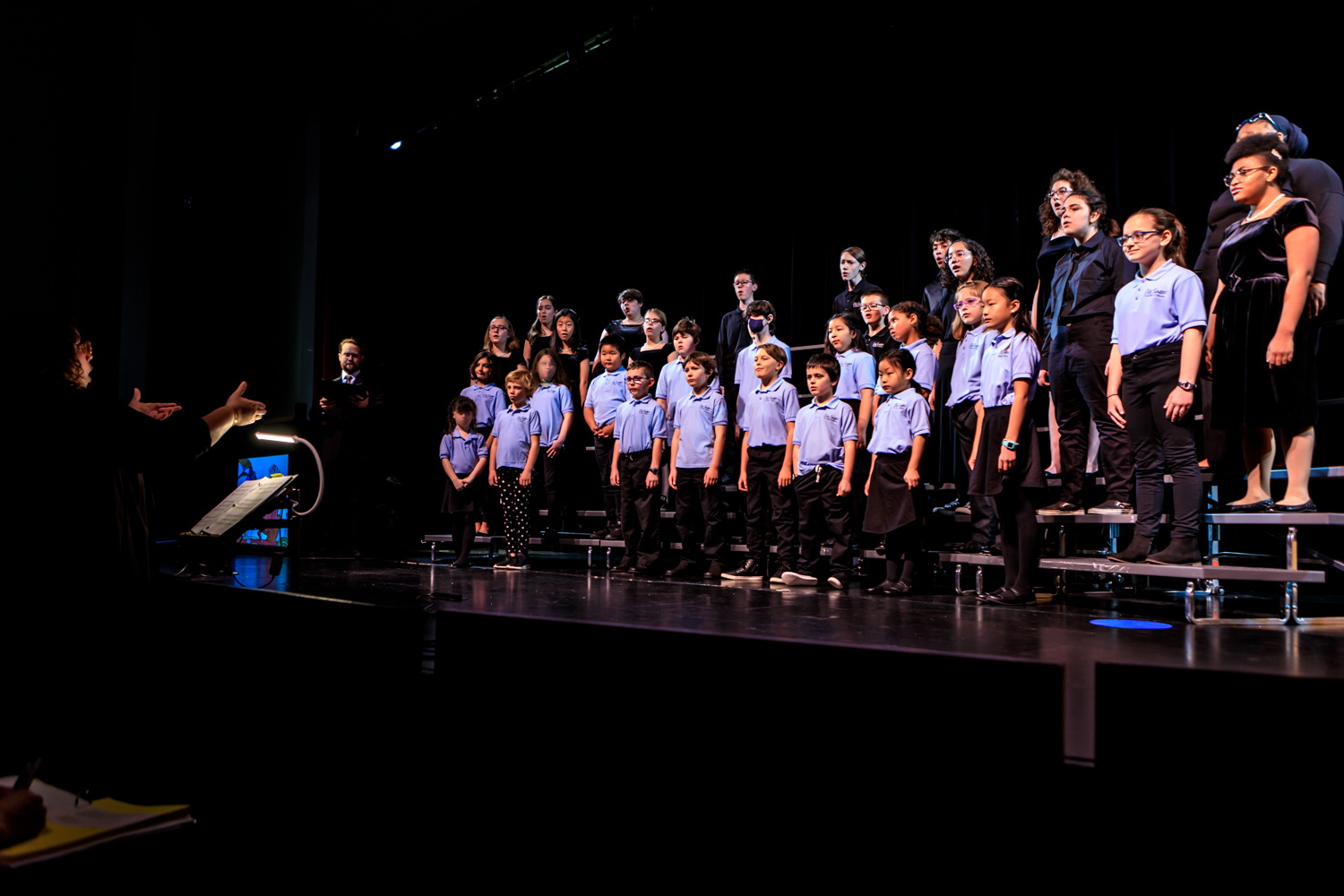
We presented the third installment of our LOVE THAT BOOK concert series, featuring Tomie dePaola’s The Legend of Old Befana on Saturday, Dec 3, 2022. Here are some excerpts from the program:
DIRECTORS’ NOTES A story as apt now as it was in busy 9th century Rome, today’s ancient tale of a person too busy for an adventure offers a poignant invitation to modern people of all ages: set aside that to-do list, and spend some time on joy!
The Legend of Old Befana, originally published in 1980, is one of many dePaola books centered around his favorite holiday: Christmas! Raised Roman Catholic with an Irish mother and Italian father, dePaola grew up in the rich storytelling tradition found in his family’s faith: parables, saint stories, Christmas legends, miracle tales, and more. These stories, coupled with his vibrant and accessible illustrations, he transformed into some of his best known works.
Today’s songs were selected not only for how well they fit the story, but also for their representation of historical Italian culture, language, art, and history, with the understanding that the full kaleidoscope of any culture could never be represented in only one hour.
We in City Singers Youth Choirs care about great music education, because great music does what a great story does—builds bridges between people, inspires wonder and curiosity, encourages humility and compassion.
The kids in front of you today don’t audition to be in City Singers: they simply come with a love of singing and learn the rest of it.
Recommended Materials to complement today’s concert: (we may receive donations from Amazon via these links)
Gabriella’s Song by Candace Fleming
A Venetian girl hears music all around her. A beautiful story about how music can communicate many different things to different people.
I, Vivaldi (Incredible Lives for Young Readers) by Janice Shefelman
Despite his mother’s vow for him to become a priest, young Antonio Vivaldi (one composer heard in today’s concert!) pursues his passion for music.
Food of the Italian South: Recipes for Classic, Disappearing, and Lost Dishes: A Cookbook by Katie Parla
The Worlds of Tomie dePaola: The Art and Stories of the Legendary Artist and Author by Barbara Elleman
MORE PICTURE BOOKS FROM TOMIE dePAOLA
Quiet An invitation to quieting hurry and being fully present.
The Art Lesson Tomie’s first art lessons are filled with encouragement and wisdom for budding artists of all kinds.
Christina’s Carol depicts the text of well-known Christmas carol “In the Bleak Midwinter” by Christina Rosetti (a carol performed today!)
Strega Nona When Strega Nona leaves him alone with her magic pasta pot, Big Anthony is determined to show the townspeople how it works in this classic Caldecott Honor book from Tomie dePaola.
Nana Upstairs and Nana Downstairs T Mr. dePaola’s favorite book of his own, this autobiographical tale portrays love and loss from a 4-year-old Tomie’s perspective. Re-illustrated & re-released in 2000.
4 Tips for Home Music-Making
1. Sing with each other for fun! Young children need to sing higher than most adults are comfortable. Begin with hooty owl sounds, imitate a siren or a whoop to get into that head voice! Sing high with your children to encourage pitch matching and healthy singing. We love the Boston Museum of Fine Arts Songbooks which can be found used on Amazon.
2. Use zany voices when reading aloud. From hoots or kitten meow-meow voices to deep shouty calls, the human voice possesses great dynamic range. Utilizing this full range of your reading voice is a great way to model early singing skills to children! Even, better, encourage them to join you!
3. Keep real instruments in the home. Toy instruments create a less resonant, and therefore less exciting, sound, which children are less likely to pursue through experimentation. There are many affordable options for ‘real’ instruments which will last years and years: look for Remo kids drums, metal glockenspiels by Sonor, nice-sounding ukuleles, and the ever-present free Craisgslist piano.
4. Be aware of voice-consciousness. Singing is a learned skill, not a born talent, so the popular view that ‘a person is either a singer or is not a singer’ is neither helpful nor accurate. We encourage adults never to speak ill of their voices in front of children, even if they aren’t the most comfortable singers, and use “skill” instead of “talent” when talking of musical ability. We are all learning to sing at various levels.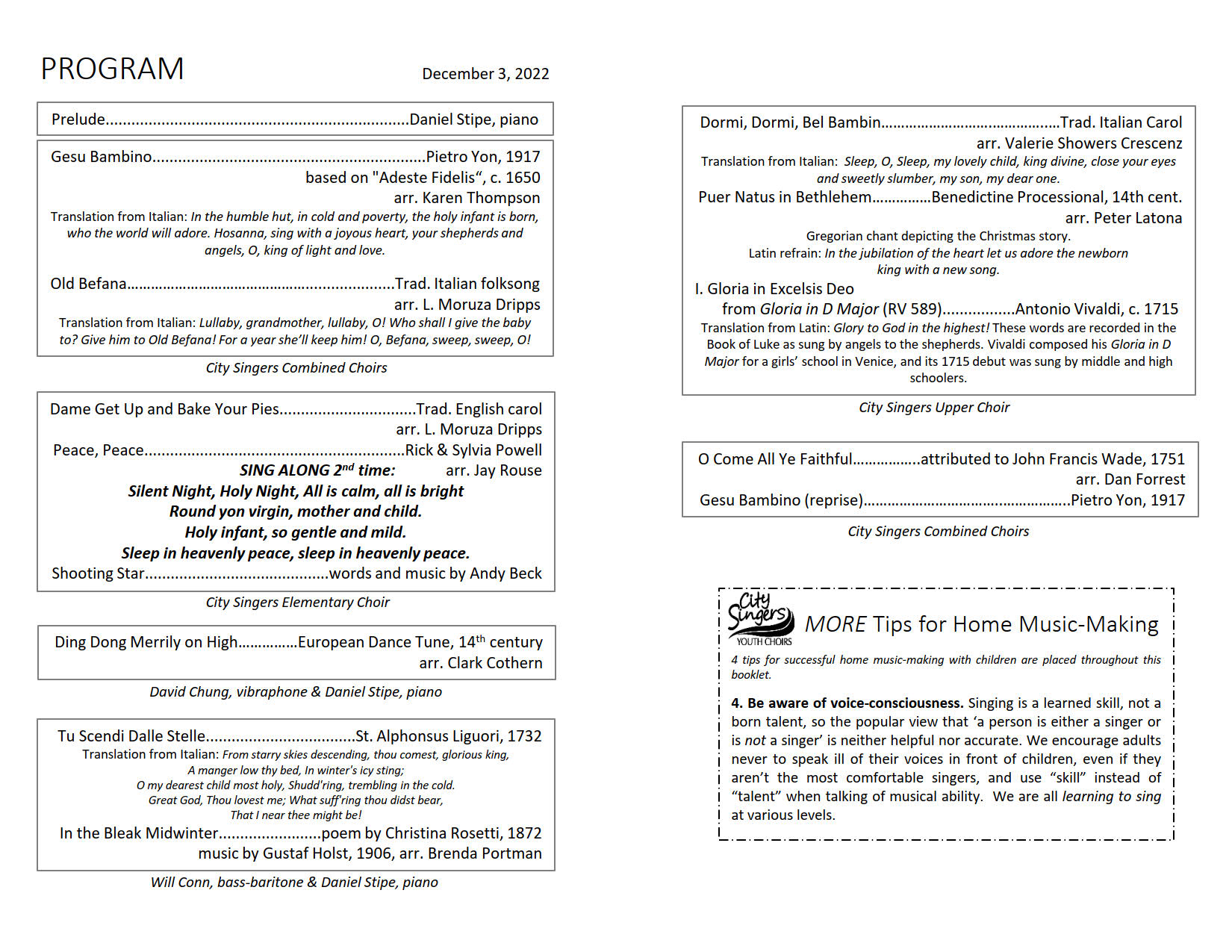

Last Updated: July 24, 2026 by testadmin
2026 THE WIDE COUNTRY: Songs Going West
19th century paintings of the Old West epically depict the wide country: achingly beautiful vistas full of equal parts promise and danger. Overlooking such a landscape, Katherine Lee Bates penned her poem “America the Beautiful,” echoing the promises of our country’s founding yet to be kept: that in this wide country there can be space for all, but too often there isn’t. It is in this tension between good promises and imperfect reality that we offer today’s concert.
The music of the Old West tells a very colorful story. When designing this concert, we wrestled with how to fairly sample not only the vast cultural diversity present in 19th century migrations to the American West, but also the range of human experiences held therein: hope, grief, promise, loss, joy, cruelty, love, despair, mercy. It did not take long to see this would be impossible. Instead, our hope is that the small taste offered today will make us all hungry for more.
Today’s theme was inspired by a few sentences in John A. Lomax’s 1912 Cowboy Songs and Other Frontier Ballads: some of the most famous songs in the book—including “Git Along Little Dogies” and “Home on the Range“—were sourced from African-American cowboys, a fact we’d encountered nowhere else. It surprised us to learn that cowhand posses were the first documented racially-integrated work teams in the U.S. with white and Black laborers on comparable footing, and after long months on the trail singing away stampedes from the minds of ornery cattle (a real thing!) a union emerged from this crucible of white Southern and African-American music: the American cowboy song.
The unveiling of these origins served as an awfully powerful invitation to continue exploring the 19th century world of people migrating to the American West: some who came through Ellis Island, some who came east from China, some who were promised 40 acres and a mule, some searching for gold, some building a railroad, and some forced to walk west from their homes at gunpoint.
A deeply important aspect of this concert is the Native American music presented. The intersection of European music notation and ethically-sourced Native American music is very small, and we took great care in evaluating each selection for authenticity, ethical sourcing, correct attribution, and performance appropriateness for a non-tribal choir like ours. We are very grateful that Native composers are bringing music from their cultures to be experienced by those outside their communities, and we especially thank Elisa Harkins, performing artist and citizen of the Muscogee Nation, for her expert guidance.
HISTORICAL & CULTURAL NOTES
While it would be impossible to provide in one concert a fair sampling of the vast cultural diversity present in the 19th century American West, below is information regarding the cultures we were able to include today, and some chronological context.
The 1803 Louisiana Purchase doubled the size of the U.S and provided a powerful impetus to westward expansion.
Georgia Gold Rush of 1829 began with the discovery of gold in Georgia, much on Cherokee land.
The Indian Removal Act of 1830 began eleven years of forcing 100,000 Indigenous People from at least 18 tribes to areas west of the Mississippi. Many of these were members of the “Five Civilized Tribes” (Cherokee, Choctaw, Chickasaw, Muscogee-Creek, Seminole) who had assimilated with their European-American neighbors, forming constitutional governments, adopting western dress and agrarian and market economies. The Cherokee brought their case before the Supreme Court and won (Worcester v. Georgia, 1832), but Pres. Andrew Jackson declined to enforce the Supreme Court’s decision. Thousands of Native American lives were lost on these journeys, dying of exposure, starvation, illness, and exhaustion; one-fourth of the Cherokee population perished on the Trail of Tears between 1838-1839. For more info: www.nps.gov/trte/learn/historyculture/what-happened-on-the-trail-of-tears.htm
The Chickasaw Nation is headquartered in Ada, Oklahoma, having been removed from eastern areas including present-day Mississippi, Alabama, Kentucky, and Tennessee. Today, it is the 12th largest Indigenous nation in the United States, with a population exceeding 80,000 citizens. Traditional Chickasaw music is community-centric: involving communal call-and-response, stomp dancing, and shell-shaking.
49ers – The California Gold Rush lasted from 1848–1855, and brought more than 300,000 new people to California. While most of the newly arrived were Americans, thousands also came from Latin America, Europe, Australia, and China. Those searching for gold were nicknamed 49ers, as 1849 was a peak year, and about half of prospectors came to California by sea, the other half over land via the California Trail. The newly developed music publication industry, which rose to prominence during the Civil War selling sheet music lionizing both the northern and southern causes, was quick to capitalize on the gold rush through tragi-comic songs written about 49ers and their travails, and almost no folk music is ascribed specifically to gold rush culture.
Homesteaders – Nearly 10 percent of the total area of the United States was given away free to 1.6 million homesteaders from 1862-1930; most homesteads were west of the Mississippi River. Any adult who had never taken up arms against the federal government of the United States could apply. Women and immigrants who had applied for citizenship were eligible. Native Americans were not allowed to file land claims under the Homestead Acts unless they renounced their tribal citizenship. The Supreme Court’s decision in United States v. Wong Kim Ark (1898), which affirmed birthright citizenship for Chinese Americans, opened the Homestead Acts to Asian Americans. Some settlers in the Dakota Territory, and later in South Dakota and North Dakota, who gained land through the Homestead Acts were Jewish or Muslim. Jewish homesteaders were largely Russian Jews fleeing pogroms in the Russian Empire.
Ellis Island—From From 1892 to 1954, about 12 million immigrants arriving at the Port of New York and New Jersey were processed there; according to one estimate, two-fifths of Americans may be descended from these immigrants.
Cowboy Songs—Cowboys sang constantly to keep the cattle calm; singing settled nervous cattle at night, and helped prevent stampedes. The integrated cowboy posse melded their distinct music traditions together, and the American Cowboy Song was born. Cattle drives were crucial to the cattle industry until the invention of barbed wire and the completion of the Transcontinental Railroad made them obsolete.
Last Updated: July 24, 2026 by testadmin
2025 Alice in a Winter Wonderland: A Wintry Mix of Arctic Story and Song
Ever had a dream you couldn’t quite describe?
Lewis Carroll’s dreamlike novel carries the reader through the most peculiar situations, and today’s retelling transports us even further! Jan Brett’s Alice in a Winter Wonderland re-sets Carroll’s original in magically delightful ways: Alice, a young Inuit girl, jumps down a glacier crevasse and travels 12,000 years into the past when humans shared the Alaskan tundra with woolly mammoths, the Great Auk, and one mysterious saber-toothed cat.
Other arctic animals also make appearances: collared pica, snowy owls, musk ox, wooly bear larva, horned puffins, Canada jays, Dall’s sheep, snow buntings, and Siberian huskies.
Today’s selections represent a few of the many cultures located in and near the Arctic Circle. The most commonly spoken language in this circumpolar region is Inuktitut and its dialects, the languages of Inuit. (“Inuit” means “the people”.) Because few Inuit composers work in the western choral tradition, and Inuit traditional music is outside our areas of experience, we set common Inuktitut greetings to music; a small way to expose our singers to their beautiful language and recognize the significance of Inuit culture and history. We thank the Inuit language keepers who have made these greetings and their translations available to the public.
Sarah Kate Walston, soprano, has played more than 30 roles in opera and musical theatre productions throughout her career; some of her favorites being Despina in Cosi fan Tutte, Pamina in Die Zauberflote, Laurie in The TenderLand, Lucia in The Rape of Lucretia and Phyllis in Iolanthe where the Baltimore Sun said “The sweet, nimble singing and deft acting of Sarah Kate Walston, as Phyllis, was a major plus throughout the performance.”
Sarah Kate also enjoys performing in recitals and concerts and has been seen performing in Germany, Belize and throughout the United States. She has sung with the Baltimore, Richmond, Annapolis, Virginia, Williamsburg, and Carmel Symphony Orchestras. Mrs. Walston has attended Lorin Maazel’s Castleton Residency for Young Artists program, the Fairbanks Summer Arts Festival, was a Young Artist with Lyric Opera Virginia, was a Young Artist at Rossini in Wildbad Germany Festival, and was engaged as a Virginia Opera Spectrum Resident Artist.
In addition to being a singer, Sarah Kate runs a private voice studio and is on the Voice Faculty of Virginia Commonwealth University. She is also a voice over artist, actor, wife and mom! A Richmond native, Sarah Kate received her Bachelor of Music degree at Lee University and her Master of Music degree and Graduate Performance Diploma at The Peabody Institute of Johns Hopkins University. She lives in Richmond Virginia with her husband J-Roddy, their daughters Bertie Darling and Echo Nightingale, and their dog Low Low.
Last Updated: July 24, 2026 by testadmin
2025 HEADWIND: A Voyage of Song
This Spring Session, we dove deep into songs traversing both the adventurous sea and the stormy waves of life.
In sailing, a headwind is a strong gust coming right at you, blowing contrary to the direction you want to go, and it seems like much of all sailing energy goes toward harnessing this opposing force. The mark of an experienced sailor is the ability to work with just about any wind—even wind going against them—to reach safe harbor.
We explored these ideas and more through the wonderful texts of our songs which include the poetry of Walt Whitman, Langston Hughes, Plato, Queen Lili’uokalani of Hawaii, John Masefield, Robert Louis Stevenson.
James Wheldon Johnson’s poem “The Gift to Sing” describes what we do here today:
And if the way grows darker still,
Shadowed by Sorrow’s somber wing,
With glad defiance in my throat,
I pierce the darkness with a note,
And sing, and sing.
Last Updated: July 24, 2026 by testadmin
2024: EL REGALO DE MI ABUELA
¡Bienvenidos a nuestra temporada 2024-25! El Regalo de mi Abuela de Eric Velásquez cuenta la encantadora y verdadera historia de la invitación de un niño al mundo poderoso del arte a través del amor de su abuela y la obra maestra del retrato Juan de Pareja del pintor español del siglo XVI Diego Velásquez.
Welcome to our 2024-25 season! El Regalo de mi Abuela (Grandma’s Gift) by Eric Velasquez tells the delightful, true story of a child’s invitation into the powerful world of art through the love of his grandmother and the masterpiece portrait Juan de Pareja by 16th century Spanish painter Diego Velasquez.
Cada semestre elegimos un tema para mejorar la experiencia musical de nuestros cantantes y audiencia, y este semestre se inspiró en la historia que escucharán hoy: exploramos la música latino-hispana de las Américas, una vasta e increíblemente diversa área de música que abarca siglos y continentes.
Every semester we choose a theme to enhance the musical experience of our singers and audience, and this semester was inspired by the story you’ll hear today: we explore Latin-Hispanic music from the Americas, a vast and incredibly diverse area of music spanning centuries and continents.
Last Updated: July 24, 2026 by testadmin
2024 FIERCE: Songs for Any Fate
FIERCE: Songs for Any Fate (Spring 2024) presented music with many kinds of creatures, real and fanciful, and their various shenanigans, all going about their business in unique ways—wily, inspiring, zany, and frumious ways!
But this is not simply a “songs of the animals” concert; there is something deeper going on! Each of these songs present another sort of ferocity: that special combination of hope and strength required to strive for a better way.
Life circumstances are often unyielding, pressuring from every side to stay still and wallow, but those who manage change—whether physical or mental or spiritual—possess a ferocity that doesn’t require teeth, but does require backbone. A person needn’t be aggressive or bossy or angry or violent to be fierce; all that is required is to know your mind and do what you must to stick to it, a posture also known as dignity.
Through these songs dealing in creatures, ferocity, dignity, and deep things, explored ingenuity, determination, defiance, steadiness, grief, love, foxes, crocodiles, birds, Emily Dickinson, Georgia Douglas Johnson, Ralph Vaughan Williams, requiems, and more. We also continued our British theme from last semester, as many of our songs come from literary works, folk tales, or traditional music of the British Isles.
Last Updated: March 16, 2024 by testadmin
The Tailor of Gloucester
Our December 2024 concert featured a reading of The Tailor of Gloucester, Beatrix Potter’s holiday tale of magic, mischief, and mice!
You probably know Beatrix Potter’s work from The Tale of Peter Rabbit, but did you know she wrote more than 60 books? Or that thanks to her detailed watercolors and study of fungi she was widely respected in the field of mycology (mushrooms and fungus)? Or that the England’s gorgeous Lake District exists in large part due to her conservation work?
Helen Beatrix Potter is one of Britain’s best known authors, but The Tailor of Gloucester may be new to you. The story tells of an aged and poor tailor, who makes his living sewing beautiful clothes for fancy customers. The story begins a few days before Christmas, and the tailor is working on an intricate vest and coat for the Mayor of Gloucester, who is getting married on Christmas Day. His whole living depends upon getting the Mayor his clothes in time! All the pieces of fabric have been cut out and are ready for sewing as the tailor leaves for the day, and the last thing the tailor needs to complete his work is a bit more cherry-colored thread (which in this story is called twist), just enough for one button-hole! But he falls ill that night, and his naughty cat, Simpkin, plays a naughty trick on him. Will the tailor finish his work in time?
Last Updated: April 26, 2023 by testadmin
The Legend of Old Befana
We presented the third installment of our LOVE THAT BOOK concert series, featuring Tomie dePaola’s The Legend of Old Befana on Saturday, Dec 3, 2022. Here are some excerpts from the program:
DIRECTORS’ NOTES A story as apt now as it was in busy 9th century Rome, today’s ancient tale of a person too busy for an adventure offers a poignant invitation to modern people of all ages: set aside that to-do list, and spend some time on joy!
The Legend of Old Befana, originally published in 1980, is one of many dePaola books centered around his favorite holiday: Christmas! Raised Roman Catholic with an Irish mother and Italian father, dePaola grew up in the rich storytelling tradition found in his family’s faith: parables, saint stories, Christmas legends, miracle tales, and more. These stories, coupled with his vibrant and accessible illustrations, he transformed into some of his best known works.
Today’s songs were selected not only for how well they fit the story, but also for their representation of historical Italian culture, language, art, and history, with the understanding that the full kaleidoscope of any culture could never be represented in only one hour.
We in City Singers Youth Choirs care about great music education, because great music does what a great story does—builds bridges between people, inspires wonder and curiosity, encourages humility and compassion.
The kids in front of you today don’t audition to be in City Singers: they simply come with a love of singing and learn the rest of it.
Recommended Materials to complement today’s concert: (we may receive donations from Amazon via these links)
Gabriella’s Song by Candace Fleming
A Venetian girl hears music all around her. A beautiful story about how music can communicate many different things to different people.
I, Vivaldi (Incredible Lives for Young Readers) by Janice Shefelman
Despite his mother’s vow for him to become a priest, young Antonio Vivaldi (one composer heard in today’s concert!) pursues his passion for music.
Food of the Italian South: Recipes for Classic, Disappearing, and Lost Dishes: A Cookbook by Katie Parla
The Worlds of Tomie dePaola: The Art and Stories of the Legendary Artist and Author by Barbara Elleman
MORE PICTURE BOOKS FROM TOMIE dePAOLA
Quiet An invitation to quieting hurry and being fully present.
The Art Lesson Tomie’s first art lessons are filled with encouragement and wisdom for budding artists of all kinds.
Christina’s Carol depicts the text of well-known Christmas carol “In the Bleak Midwinter” by Christina Rosetti (a carol performed today!)
Strega Nona When Strega Nona leaves him alone with her magic pasta pot, Big Anthony is determined to show the townspeople how it works in this classic Caldecott Honor book from Tomie dePaola.
Nana Upstairs and Nana Downstairs T Mr. dePaola’s favorite book of his own, this autobiographical tale portrays love and loss from a 4-year-old Tomie’s perspective. Re-illustrated & re-released in 2000.
4 Tips for Home Music-Making
1. Sing with each other for fun! Young children need to sing higher than most adults are comfortable. Begin with hooty owl sounds, imitate a siren or a whoop to get into that head voice! Sing high with your children to encourage pitch matching and healthy singing. We love the Boston Museum of Fine Arts Songbooks which can be found used on Amazon.
2. Use zany voices when reading aloud. From hoots or kitten meow-meow voices to deep shouty calls, the human voice possesses great dynamic range. Utilizing this full range of your reading voice is a great way to model early singing skills to children! Even, better, encourage them to join you!
3. Keep real instruments in the home. Toy instruments create a less resonant, and therefore less exciting, sound, which children are less likely to pursue through experimentation. There are many affordable options for ‘real’ instruments which will last years and years: look for Remo kids drums, metal glockenspiels by Sonor, nice-sounding ukuleles, and the ever-present free Craisgslist piano.
4. Be aware of voice-consciousness. Singing is a learned skill, not a born talent, so the popular view that ‘a person is either a singer or is not a singer’ is neither helpful nor accurate. We encourage adults never to speak ill of their voices in front of children, even if they aren’t the most comfortable singers, and use “skill” instead of “talent” when talking of musical ability. We are all learning to sing at various levels.
Last Updated: May 26, 2022 by testadmin
Come to My Garden
Excerpt from our 5/14/2022 concert notes:
If our theme today looks familiar, it’s because it is: “Come to My Garden” was the 2020 City Singers Spring Session theme, which for obvious reasons was never performed. How happy we are to present this music today, and how relevant the theme; while effects of the pandemic seem to be waning, uncertainty persists in this wild world, and yearning for the sanctuary a garden embodies is something each of us can understand.
Singing together this season has breathed new life into all of us here in City Singers: the resilience, positive spirit, and love that each of our young people bring to rehearsal every week is consistently amazing.
Last Updated: March 8, 2022 by testadmin
All-of-a-Kind Family Hanukkah
Excerpt from our 12/4/2021 concert program: We are excited to share with you one of our favorite story books, All-of-a-Kind-Family Hanukkah, and the music we’ve paired with it. The story is set in New York City around the year 1900, on the first night of Chanukah.
Did you notice that throughout this program, ‘Hanukkah’ is not always spelled the same? The Oxford English Dictionary lists 24 different spellings of the holiday, and there’s a good reason: the Hebrew language doesn’t use English letters, so people had to figure out what English letters best represent the Hebrew letter sounds so we can pronounce it.
This is called transliteration, and different ways to spell ‘Chanukah’… or ‘Hanukkah’… are used today in English, although they are all pronounced the same. For more, see “How Do You Spell Channukkah?” by the LeeVees on Cantor Sarah’s playlist!
Inside this program are coloring pages of three historic stained glass windows found here in this sanctuary. Can you find each one? You are welcome to copy the colors found in the originals, or come up with your own! Coloring pencils and extra pages are available at the entrance.
Today’s instruments include piano, clarinet, accordion, solo voices and choir voices. If you look carefully at the accordion, can you see that a piano keyboard is a part of it?
Look at the two big menorahs on either side of the stage. How many candles are on each? If you counted 7, you are correct! It is only the special Hanukkah menorah which has 9 candles, 8 to represent the 8 miraculous nights of oil, and one to light them with, the shamash, or helper, candle.
In our story it is the first night of Hanukkah, but tonight is actually the last night of Hanukkah. In our story, Gertie gets to light the first candle, but tonight you get to see all candles lit at the end of the concert!
Voices are a big part of our music, and you’ll hear two kinds today: solo voice and choir. We have two soloists, each with very different voices, but both are categorized as soprano, which is the highest adult voice. Our choral voices are made up of kids like you, who love to sing! These kids meet once a week to learn music and how to sing in the strongest and healthiest way.
If you love music and love to sing, you can be a part of City Singers! Learn how to join us here.
Last Updated: December 5, 2022 by admin
To toot or not to toot? Stuff we’re proud of…
A note from Leslie Dripps, CSYC Executive & Artistic Director
When the going gets tough, (and if you run a non-profit, you know that it can) sometimes one stops everything and thinks “WHY AM I DOING THIS CAN’T SOMEBODY ELSE DO IT I WANT TO TAKE A NAP!” ..and then I take a breath.
In that breath I remember the reason I work for this particular organization, and not anyone else, is that we do a fabulous job in a way that sets us apart from other groups in our area. Dare I say that? Well, we’ve worked hard at these things, and we are proud of them!
“What,” they ask with baited breath, “sets you apart?” (Narrator: They did not ask that.)
Well, since I am not only a choir director, but also a choir mom, the stuff that sets City Singers apart is the stuff that I value the most when it comes to the activities my own children do. (All three are City Singers!)
Here are three elements which set City Singers Youth Choirs apart:
1. CSYC is the only Richmond area community youth choir led by faculty with degrees in voice and voice education. (I look forward to the day when we aren’t alone here). Our training and experience is in teaching the young voice and developing our singers through the lens of singing in ways that best serve the singers. This distinction is important—college degrees in instruments other than voice are not designed to prepare for teaching the youth voice. We highly value the science, research, and best practices in voice pedagogy, and maintain the most current knowledge in the field to apply in our choirs. We know vocal anatomy, and the anatomical and biological elements significant in the pubescent voice change. We highly value our positive reputations in the music education community, and CSYC is recommended by area choir teachers. Read faculty bios here: www.citysingerschoir.org/faculty
2. We respect our singers and their voices. Unfortunately, this sets us apart. Questionable (and by this I mean ‘abusive’) management practices are very common in the youth arts world, and are often excused as a mark of “quality”, which we find appalling on the most fundamental level. We never, ever yell, and never have, for more than 20 years. We prioritize singer health (mental, emotional, and physical) and design our rehearsals and performances to support this health. Singers are proud of the high quality we accomplish together, and that pride inspires more dedicated and diligent practicing and better music. Knowing how youth voices develop is crucial to this approach, and our vocal pedagogy and philosophy, superior in their own right, contribute to joyful and productive rehearsals.
3. City Singers is a stable organization. This may not sound exciting, but it totally is. We have a robust strategic plan, which guides our program and governance decisions, an annual transparent funding strategy, and have never in our history operated in the red or had a deficit. Our volunteer Board of Directors is made up of community members who value our mission: leaders in Richmond’s business sectors and music education sectors.
So, there you go. I could go on and on about the quality of our musicianship and repertoire, but these three matter to me as a mom. Our quality flows out of these. Won’t you join us?