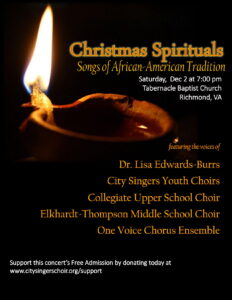
 This December, City Singers Youth Choirs was delighted, blessed, inspired and grateful to collaborate with Elkhardt-Thompson Middle School (a City of Richmond public school), Collegiate School (an independent school) , One Voice Chorus Ensemble (a community choir of singers dedicated to racial equity) and the marvelous Dr. Lisa Edwards-Burrs, Soprano, on this Christmas Spirituals: Songs of African-American Tradition concert. Here’s a sampling of our program notes:
It seems that every year about this time we hear a renewed longing for ‘peace on Earth, good will toward men’ and the Spiritual songs from African-American tradition encapsulate that longing in a way no other art form does. We invite you to read a brief history of Spirituals on page 4 of this program. There you will find explanations of the genre and its origins and discover how a work song in a cotton field sung by captive Africans made its way to the fanciest concert halls in America.
We would have loved to sing every Spiritual we could get a hold of, but alas, time limits! While one concert cannot represent the full breadth and depth of the Spiritual literature, a careful listener will hear echoes of both the hardships and joys from which each song was born, from the most energetic selections to the sweetest lullaby.
Our singers have been on a journey of discovery through these songs–a challenging, beautiful journey–all the things that come with trying to touch another’s experience. We would like to humbly acknowledge the varied opinions of African Americans regarding the performance of Spirituals. The great tree which is the Spiritual Tradition was grown from both the blood and the irrepressible spirit of the enslaved Africans who created each song. Our purpose is to celebrate and honor the enduring artistic, social and historical contribution those men and women have given to America and the world.
~ Leslie Dripps & Mara Smith, Directors, City Singers Youth Choirs
True enough this music was transmitted to us through humble channels, but its source is that of all great art everywhere—the unquenchable, divinely human longing for a perfect realization of life. It traverses every shade of emotion without spilling over in any direction. Its most tragic utterances are without pessimism, and its lightest, biggest moments have nothing to do with frivolity. In its darkest expressions there is always a hope and in its gayest measures a constant reminder.
Hall Johnson (1888-1970), Composer
A Brief History of Spirituals
The term “Spiritual” describes the songs created and sung by enslaved Africans in North America from as early as 1650. Although widely thought to have evolved gradually from group music making over the years, research now supports the idea that specific individuals (not groups) likely created most of the body of work, weaving African and European influences together into a new art form and teaching these songs to their communities. This oral transmission fostered a fluidity which allowed for variation. The first written arrangements of the Spiritual for formal concert use were performed by the Fisk Jubilee Singers in 1871. This is considered the birth of the “concert spiritual”, a formalized iteration of an oral art form, and the Fisk Jubilee Singers, through tireless dedication through much trial and hardship, brought the Spirituals to the entire world. The Spiritual songs of the enslaved Africans have woven the very fabric of most of the body of modern western music–blues, rock, gospel, jazz, pop, hip-hop–the reach and influence of the Spirituals cannot be overstated.
Spirituals have been categorized into five thematic groupings: religious spirituals, freedom spirituals, escape spirituals, shouts and hollers, and work songs. Within each of these categories is a wide and various emotional diversity, from slow and sorrowful to fiery and syncopated.
The songs presented here generally fall within the narrow confines of the concert spiritual with a bit of gospel in the mix. Also, while sorrow songs, a significant segment of the Spirituals genre, are missing in today’s concert, their echo is in every Spiritual song. H.T. Burleigh, one of the preeminent arrangers of concert Spirituals, wrote about them thus:
The cadences of sorrow invariably turn to joy, and the message is ever manifest that eventually deliverance from all that hinders and oppresses the soul will come, and man, every man, will be free. -H.T. Burleigh (1866-1949)
W.E.B. Du Bois, in his seminal work, The Souls of Black Folk, concludes:
Sometimes [Spirituals display] a faith in life, sometimes a faith in death, sometimes assurance of boundless justice in some fair world beyond. But whichever it is, the meaning is always clear: that sometime, somewhere, men will judge men by their souls and not by their skins.
-W.E.B. Du Bois (1868-1963)

Posted: August 14, 2018 by admin
Music for Most of Us (Episode 2)
Beyond Appreciation: Building Family Music Literacy at Home
If you, like me, are on a homeschooling adventure, you have probably encountered music appreciation elements in various curricula. These tend to include music from the Western classical tradition, listening activities, instrument families and identification, historical periods, tie-ins with visual art and even some creative movement. You have also probably encountered a wide variety of private lesson methods: from the Suzuki method, to the Russian piano school, and everything in between.
As a college trained music educator, having earned a teaching license for grades k-12 vocal music and worked in the field for almost twenty years, I can tell you that all these things are good and fine. Well, you ask, what’s missing? Glad you asked.
In short, Music Appreciation isn’t literacy, and in all fairness, it doesn’t really claim to be. Music literacy involves comfort with music-making and creation, and is a pretty straightforward series of skills that can be learned.
I present to you four simple touchstones that indicate beginning progress toward the fundamentals of music literacy, and they are easy to learn at home, and appropriate to start with ages 4 and up (some 2-3 year olds may be inclined as well, if older siblings are doing it, or if they LOVE singing, or are geniuses.) I recommend singing these exercises together during read-aloud time, memory work, or any other time everyone is snuggled on the couch.
1. Sing a major scale
Do, Re, Mi, Fa, Sol, La, Ti, Do, Do, Ti, La, Sol, Fa, Mi, Re, Do
2. Sing a major scale + this pattern:
Do Re Mi Fa Sol La Ti Do Do Ti La Sol Fa Mi Re Do
Do____Sol____Do Mi Sol Mi Do__Fa Fa Sol Sol Do
Follow @citysingerschoir on Instagram for this video!
3. Sing three different major scales+pattern, beginning each scale on a randomly selected pitch.
Follow @citysingerschoir on Instagram for this video!
4. Improvise using the pentatonic scale (black notes on the piano keyboard: Do, Re, Mi, Sol, La)
Follow @citysingerschoir on Instagram for this video!
You may notice at this point that these activities are not usually presented in music appreciation courses, or sometimes even private lessons. We tend to get very performance-centric when we study music, and this can result in ignoring the most basic skills in favor of getting ready for the concert. This is a pity, because with these skills, music becomes fathomable, creatable, and our own.
So, go practice! I plan to continue this series throughout this year. Stay tuned for Part 2: If Your Mama Plays Accordion
Be well, and sing on!
Leslie Dripps
Last Updated: July 15, 2021 by admin
Christmas Spirituals: Songs of African-American Tradition
It seems that every year about this time we hear a renewed longing for ‘peace on Earth, good will toward men’ and the Spiritual songs from African-American tradition encapsulate that longing in a way no other art form does. We invite you to read a brief history of Spirituals on page 4 of this program. There you will find explanations of the genre and its origins and discover how a work song in a cotton field sung by captive Africans made its way to the fanciest concert halls in America.
We would have loved to sing every Spiritual we could get a hold of, but alas, time limits! While one concert cannot represent the full breadth and depth of the Spiritual literature, a careful listener will hear echoes of both the hardships and joys from which each song was born, from the most energetic selections to the sweetest lullaby.
Our singers have been on a journey of discovery through these songs–a challenging, beautiful journey–all the things that come with trying to touch another’s experience. We would like to humbly acknowledge the varied opinions of African Americans regarding the performance of Spirituals. The great tree which is the Spiritual Tradition was grown from both the blood and the irrepressible spirit of the enslaved Africans who created each song. Our purpose is to celebrate and honor the enduring artistic, social and historical contribution those men and women have given to America and the world.
~ Leslie Dripps & Mara Smith, Directors, City Singers Youth Choirs
True enough this music was transmitted to us through humble channels, but its source is that of all great art everywhere—the unquenchable, divinely human longing for a perfect realization of life. It traverses every shade of emotion without spilling over in any direction. Its most tragic utterances are without pessimism, and its lightest, biggest moments have nothing to do with frivolity. In its darkest expressions there is always a hope and in its gayest measures a constant reminder.
Hall Johnson (1888-1970), Composer
A Brief History of Spirituals
The term “Spiritual” describes the songs created and sung by enslaved Africans in North America from as early as 1650. Although widely thought to have evolved gradually from group music making over the years, research now supports the idea that specific individuals (not groups) likely created most of the body of work, weaving African and European influences together into a new art form and teaching these songs to their communities. This oral transmission fostered a fluidity which allowed for variation. The first written arrangements of the Spiritual for formal concert use were performed by the Fisk Jubilee Singers in 1871. This is considered the birth of the “concert spiritual”, a formalized iteration of an oral art form, and the Fisk Jubilee Singers, through tireless dedication through much trial and hardship, brought the Spirituals to the entire world. The Spiritual songs of the enslaved Africans have woven the very fabric of most of the body of modern western music–blues, rock, gospel, jazz, pop, hip-hop–the reach and influence of the Spirituals cannot be overstated.
Spirituals have been categorized into five thematic groupings: religious spirituals, freedom spirituals, escape spirituals, shouts and hollers, and work songs. Within each of these categories is a wide and various emotional diversity, from slow and sorrowful to fiery and syncopated.
The songs presented here generally fall within the narrow confines of the concert spiritual with a bit of gospel in the mix. Also, while sorrow songs, a significant segment of the Spirituals genre, are missing in today’s concert, their echo is in every Spiritual song. H.T. Burleigh, one of the preeminent arrangers of concert Spirituals, wrote about them thus:
The cadences of sorrow invariably turn to joy, and the message is ever manifest that eventually deliverance from all that hinders and oppresses the soul will come, and man, every man, will be free. -H.T. Burleigh (1866-1949)
W.E.B. Du Bois, in his seminal work, The Souls of Black Folk, concludes:
Sometimes [Spirituals display] a faith in life, sometimes a faith in death, sometimes assurance of boundless justice in some fair world beyond. But whichever it is, the meaning is always clear: that sometime, somewhere, men will judge men by their souls and not by their skins.
-W.E.B. Du Bois (1868-1963)
Posted: October 2, 2017 by testadmin
Hello world!
Welcome to WordPress. This is your first post. Edit or delete it, then start writing!
Posted: September 30, 2016 by admin
Music for Most of Us (Episode 1)
Music Lessons? 5 Tips to Get You Started
1. When should we start private lessons? Your child is older than age 6. (Please note: private voice should not begin before 8th grade—more on this later.) Private piano, violin and ukulele lessons are often dependent upon reading or pre-reading skills (like tracking left to right and top to bottom and counting) A reading five can manage with the right teacher and teaching method, but the risk is high that a child who starts too young will be frustrated easily. For children 6 and under, the most essential experience for future musicality is making music with family.
2. Which instrument should we choose? While piano is foundational to all other instruments, it may be helpful to consider what instruments are played in your family. Like language, music is absorbed environmentally by children, so if Mom plays the violin, it may be best to start there. Starting from scratch? Consider a double ukulele lesson with Daddy learning along side Junior. Have a young star singer? A children’s choir is one of the best places for young singers to develop.
3. Which teacher should we choose? With hundreds of private music teachers in the Richmond area, it may seem daunting to narrow it down, but ask around! Fellow parents know what they like about certain teachers and what didn’t work with previous ones. Your child’s school music educator is likely familiar with the teaching styles of many local instructors, and, knowing your child, can recommend a few good matches.
4. Ask for a trial period. This is often overlooked as a great step toward making the right match, so don’t be afraid to ask to book a month of lessons before committing to a particular teacher. A great music teacher knows how important it is for teacher and student to be compatible.
5. Create Goals. Draft three achievable goals with your child and present them to your teacher at the start of your trial period. He or she will gain valuable insight into what your family wants out of lessons, and will be able to fill out the goals for you with their expert musical knowledge. Make sure these goals are achievable! An achievable goal is not, for example: “We want to see if she has what it takes to Make It!” Put dreams of stardom on hold for a minute and concentrate on how learning music will benefit your child this year. He will learn that hard work improves outcomes. She will learn that ‘not getting’ something right away doesn’t mean she’ll never get it. He will learn that he has the power to create something beautiful. Achievable short term goals could include: playing ‘happy birthday” for so and so’s special day, playing a holiday song for grandma’s visit, auditioning for a school group. Long term goals include preparing for college auditions (it takes years!), learning to read music competently, fostering a deeper appreciation for the musical arts, becoming a well-informed audience member. Keep your goals in an accessible place, and reevaluate often with your child and teacher.
Now, sit back, enjoy the music and crack the whip! Whoops—“How to Practice” is another article entirely….
Posted: November 27, 2015 by admin
Your instrument is your body!
Your instrument is…your entire body!
A singer’s instrument is the entire body. Even how your toes point can ultimately affect what you sound like! It’s important to know how it all works together, and how to keep the body humming along, so you can keep…well…humming along!
Fran Coleman (D.M.A., Board Member, Capitol Opera Richmond, Deputy Director, Classical Revolution RVA, Adjunct Professor, John Tyler Community College, Longwood University, Owner/Teacher, Songbird’s Studio–so she KNOWS what she’s talking about) recently presented on Vocal Health and Hygiene at our SongTalks program in September.
Here are Fran’s top ways to keep your voice (and body) healthy:
Voice Health Tip #1. HYDRATE, HYDRATE, HYDRATE
Dehydration (not enough water in your body) occurs externally and internally.
External dehydration may come from breathing dry air, breathing with an open mouth, smoking, and certain drying oral medications like antihistamines. To help allergies without dehydrating, try nasal steroid sprays (prescription and over-the-counter versions now available!)
Your vocal folds can be re-hydrated by inhaling steam (i.e. hot shower, facial steamer, hot-water vaporizer).
Internal dehydration comes from too much caffeine, alcohol, drying drugs, or sweating without
fluid replacement. Internal re-hydration is probably best achieved by drinking lots of water.
How much water should you drink per day? Divide your body weight in hal f! This is the MINIMUM number of ounces you should be drinking per day.
Voice Health Tip #2. AVOID EXCESSIVE VOCAL STRAIN
Throat Clearing/Coughing When a person clears his throat or coughs, the vocal folds violently crash together, which can cause inflammation, which causes loss of singing and speaking range or a husky-sounding voice. Untreated inflammation can cause serious long-term vocal damage.
Clearing your throat or coughing is usually due to excessive mucous. (The stuff just got real, folks.) Mucous will drain from sinuses down the back of the throat, irritating the vocal folds and causing a cough.
-To reduce mucous and therefore coughing, treat allergies or infection promptly by following advice from your doctor.
-To prevent mucous and therefore coughing, use a nasal irrigation system regularly, especially during dry weather, cold weather, flu season, allergy season. One such system is NeilMed sinus irrigator, available at drug stores everywhere.
Shouting in excess causes severe vocal strain. Avoid shouting, and absolutely avoid screaming.
Vocal Health Tip #3. STAY RESTED
If your body is tired, your vocal cords are tired, too! Get a good night’s sleep, regularly.
Vocal Health Tip #4. EAT WELL & EXERCISE!
As singers we are vocal athletes. We must train our bodies the same way.
Avoid:
● Sugar
● Fatty foods
● Preservatives
● Dairy (2 hours before performance)
Eat:
● Fruits
● Vegetables
● Whole grains
Build:
● Cardiovascular strength, which creates pulmonary and muscular stamina
Vocal Health Tip #6. DO NOT SING SICK!!!
Refrain from singing if you have:
● an infection, virus, or fever
● Laryngitis
○ When we are hoarse, our cords are swollen. Singing on swollen cords is like
running on a sprained ankle – IT’S NO GOOD!
Posted: February 4, 2015 by admin
Songs for Peace: Wintertide Concert 2015
I know I’m not the only one who has been avoiding the news. It seems a tide of darkness threatens from almost every story. What can we possibly do?
Well, Mara Smith, Margaret Taylor and I are lucky enough to work with young people who are weekly ‘doing something’. They are more actively engaged in understanding differing cultures, cultivating brotherhood, and practicing empathy than any other program I know of: they sing together. They sing songs from around the world and across the ages, songs of kings, songs of slaves, songs of the holy, songs of war, songs of pain, songs of hope.
One song may seem a small thing, but many voices singing as one? That’s powerful. That’s the power of song.
Posted: April 3, 2014 by admin
Believe in the Power of…Fun?
In a recent survey of community choir leaders across America, they listed “artistic excellence” as what they thought most attracted families to their choirs. A second survey polling families already involved in community choirs asked the same question. Parents responded with…dum…dum…dee…dum…..”Fun!”
So, join us! City Singers Youth Choirs is…..FUN! Click here to register for auditions, being held on May 3 and July 26. Auditions are fun, too, yall.
Posted: November 7, 2013 by admin
Who needs a spa when we’ve got choir?
I am like you: sometimes I dread work. “Ahhh,” I sigh, like an overstuffed cat, “Can’t I just sit here and eat bon-bons by the fire a little longer? Do I have to go to work?”
Except.
Except.
I actually never say that. I never call choir rehearsal “work”. Email? That’s work. Paperwork? Yep. Uniform ordering? Fireside bon-bons, please.
But choir rehearsal is not work. I will come in to rehearsal after a long day with my little ones (yes, motherhood is often work) and with the first community breath we all breathe together, the kinks release and a beautiful spinning note out of the mouths of our singers dances over me and they are giving their best and I am giving my best and we are singing together and concentrating together and yes working together and suddenly we are alive.
At the end of rehearsal, we depart full of hope for what we have and can accomplish. Full of the promise of beauty that has filled us up and overflowed and has been shared. Yeah. Believe it. Believe in the Power of Song.
Posted: November 7, 2013 by admin
Looking back as we look ahead…
Blog? What blog? Last season we were so busy doing, there was little time to record it! Everything was positively magical, and I’d be hard pressed to rate them. So, since each is a winner, I’m giving them all #1. Here are a few which come immediately to mind:
#1 City Singers Children’s Choirs sings in Let it Snow with the Richmond Symphony, conducted by Erin Freeman.
#1 Attending a City Singers Children’s Choirs Civil War concert featured as #6 of Richmond Magazine’s “31 Things You Must Do in 2013” (December ’12) We’re in the top 13 of 2013..just sayin’…
#1 City Singers Children’s Choirs give December Caroling and Valentine’s Day performances at MCV’s palliative and heart units. Our singers learned about the power of song on those days.
#1 City Singers Children’s Choirs present Richmond debut of Legacy at Civil War and Emancipation Day, hosted by the Amercian Civil War Center at Historic Tredegar.
#1 Our choristers mastered a wide variety of music from and inspired by the Civil War and presented them in our two major concerts. Spirituals and folksongs of the enslaved Africans, parlor songs of the North and South, Appalachian folk hymns, patriotic battle songs, children’s game songs. With the help of the Virginia Historical Society and Dr. Jonathan White of Christopher Newport University City Singers Children’s Choirs presented two concerts of academic significance and moving beauty.
#1 We took our Civil War Songs on the road to DC and Gettysburg for the Civil War Sesquicentennial. Words. Cannot. Do. Justice. Awesome.
I could go on and on and on…but it’s time to look ahead! Won’t you join us for our next great adventure?
Posted: July 12, 2013 by admin
Hits and Highlights: DC/Gettysburg Choir Tour 2013
Hits and Highlights: DC/Gettysburg Choir Tour 2013
It was our singers’ idea. We had been told that unsanctioned singing was considered a form of protest at the memorials, and had thusly restrained ourselves during a day of sight seeing (mostly), but as Daniel gave us an F, and I faded to the back of the group, they one by one raised their voices in The Star Spangled Banner, one joining another, until all were singing, and passersby and tourists paused to place hands over hearts.
That spine tingle? That’s it. That’s the feeling of the Big Choir Tour Moment, the moment each singer and chaperone would carry with them, despite the grandeur of other venues, and humor of friends new and old; our Big Moment was singing our National Anthem at the Lincoln Memorial.
Isn’t it funny that video can’t come close to capturing the power of the moment? You’d think that with aural and visual it would be just like being there, but it’s not. What I remember from that moment is standing in the back of the group, looking behind us, up the stairs, past the columns, the dark sillouettes of sparrows darting against a sunset-lit sky, everything tinged with gold, and the moment that all voices came together, despite the fact that some among us were sure we’d get arrested: the sweet, strong voices of our singers gaining momentum as one by one they join in song, the war veteran beside me placing his cap over his heart, a group of very special young people who had just experienced the awe of the Lincoln Memorial, read his words on its walls, and respond of their own accord by singing our National Anthem. [And we were not arrested. Success!]
Thank you to our tireless and patient chaperones! They cared for our singers with joy and kindness and really made the trip doable. Thank you to our responsible singers: as expected, not one discipline issue. Thank you to Sarah, our marvelous tour manager, and to Larry, the Best Bus Driver in the World (he parallel-parked that sucker!). And thank you, thank you, thank you to our tour sponsors through whose donations our trip was made possible:
Dr. Sujit Mohanty D.D.S., Ardyth Lohuis, ML Bell Construction, Gary and Margaret Barnard, Betsy Gallagher, Richard H. Villa DMD PC, William T. Lucas D.D.S., APE International, LLC, Dr. Pamela F. Regimbal of Aloha Orthodontics, Mary Bergstrom, Total Footcare P.C.,
and Carolyn Harper.
One last word: How can it be that despite face-melting sun the choir can still sound so gooooooood. Visit us on Facebook for more pictures and links to video. Believe in the Power of Song!